

complete step-by-step PQC road construction process including ground preparation, leveling, formwork, dowel bars, M-40 concrete pouring, finishing, and curing. This detailed guide explains the full Pavement Quality Concrete (PQC) method used in highways and heavy-load roads, along with practical site experience insights for better construction quality and durability.
Pavement Quality Concrete (PQC) road construction is a method used to build strong and durable rigid pavements suitable for heavy traffic conditions. It involves proper ground preparation, compaction, formwork installation, reinforcement placement, concrete pouring, and finishing in a systematic sequence. M-40 grade concrete is commonly used to ensure high strength and long service life. The process also includes precise leveling, joint detailing, and controlled curing to achieve the required durability and performance of the road surface.
Based on my experience working on site, I have observed that accuracy in leveling, proper alignment of channels, and timely finishing play a very important role in the final quality of PQC work. Small mistakes during setting or concreting can lead to surface irregularities or joint issues later, so careful supervision at every stage is essential.
MoRTH (Ministry of Road Transport & Highways Guidelines) FHWA Concrete Pavement ResourcesStep-by-Step Construction Process (PQC Road Work)
- Perform ground cleaning and leveling using JCB.
- Take all levels (NGL) before starting work.
- Start compaction of the ground properly.
- Refer to drawings and divide the working area into panels.
- PQC thickness is generally 150–300 mm depending on load and usage.
- Install channels (formwork) as per layout.
- Set channel levels as per drawings.
- Provide 100 mm PCC below the base.
- Fix channels properly and ensure alignment.
- Use auto level to verify channel levels.
- Start fixing dowel bars in joints.
- Add 50 mm thick mortar/concrete to match channel height where required.
- Pour PQC concrete (M-40 grade) using RMC truck.
- Add steel fibers at 12 kg per cubic meter (if specified).
- Use needle vibrator for proper compaction.
- Around 8 laborers are typically required for execution.
- Use screed and long phanti for finishing work.
- After 1 hour of concreting, use floater for final finishing.
- Remove side channels after 48 hours to 3 days.
- Start curing immediately after finishing.
- Curing should continue for 14 days for proper strength development.
- After completion of 14 days curing, make grooves/cuts of 25 mm depth as per requirement.
- Fill the grooves/cuts with sealing chemical (joint filler) for durability and crack control.
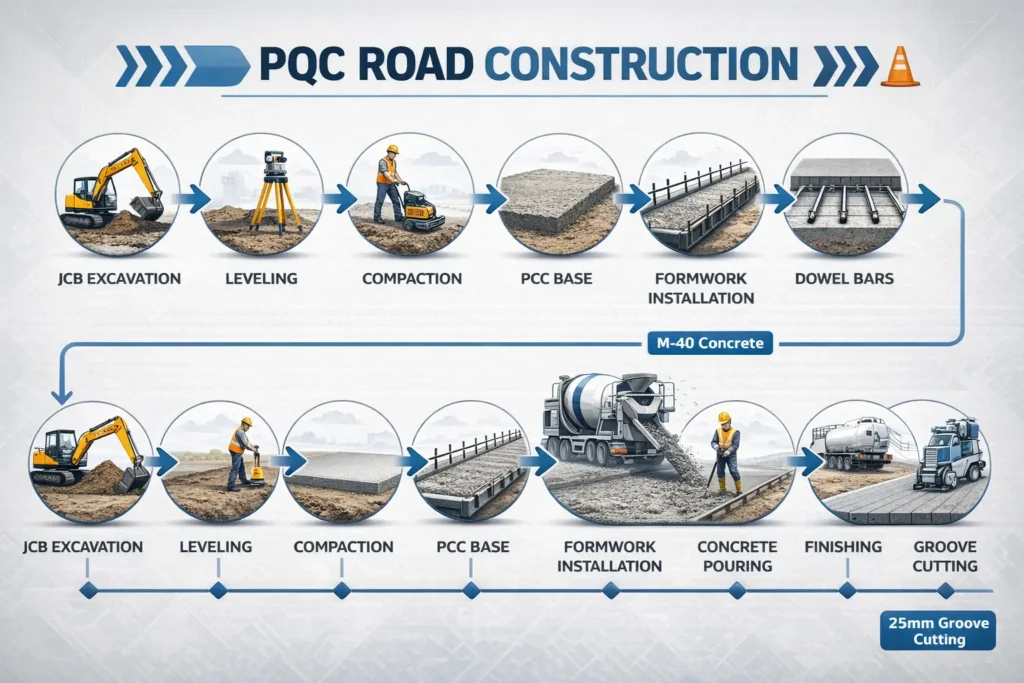
PQC WORK – SITE EXECUTION FLOW (INFRASTRUCTURE)
📊 PQC Road Construction – FAQ Infographics
PQC is a rigid pavement system using high-strength concrete for durable roads.
Highways, airports, industrial zones, and heavy traffic roads.
M-40 grade concrete is commonly used.
150 mm to 300 mm depending on load design.
Ground cleaning and leveling using JCB.
NGL levels are taken before starting work.
Ground is compacted for strength and stability.
Area is divided into panels as per drawing.
100 mm PCC is provided as base layer.
Channels are installed and aligned for concreting.
Used for accurate level checking of channels.
Used for load transfer between slabs.
12 kg per m³ added for extra strength (if required).
RMC trucks are used for M-40 concrete delivery.
Needle vibrator removes air gaps.
Approx. 8 workers required per activity.
Screed and long phanti used for surface finishing.
Floater used after 1 hour for smooth surface.
Removed after 48 hours to 3 days.
Started immediately after finishing.
Minimum 14 days required.
Done after 14 days at 25 mm depth.
Chemical sealant used in grooves.
Long life, high strength, and low maintenance roads.

Hi! I’m Sandip, a civil engineer who loves sharing about Civil Engineering & new ideas and tips. My blog helps you learn about engineering in a fun and easy way!