
Table of Contents
A Complete Guide to PQC Concrete: Mix Design, Grade, Thickness, DLC vs. PQC, and More
You probably know the term “PQC concrete” if you are a civil engineering student, a site engineer, or a quantity surveyor. This is especially true for highway and rigid pavement projects.
From my own experience on the job, PQC concrete was one of the most important layers on road projects. If you make a small mistake in the design of the PQC concrete mix or the PQC concrete slump, it can have a direct impact on the road’s life.
I will explain everything about PQC concrete in this article in a way that is very easy to understand and useful for tests and work on the site.
What is PQC in Concrete?
PQC concrete full form = Pavement Quality Concrete
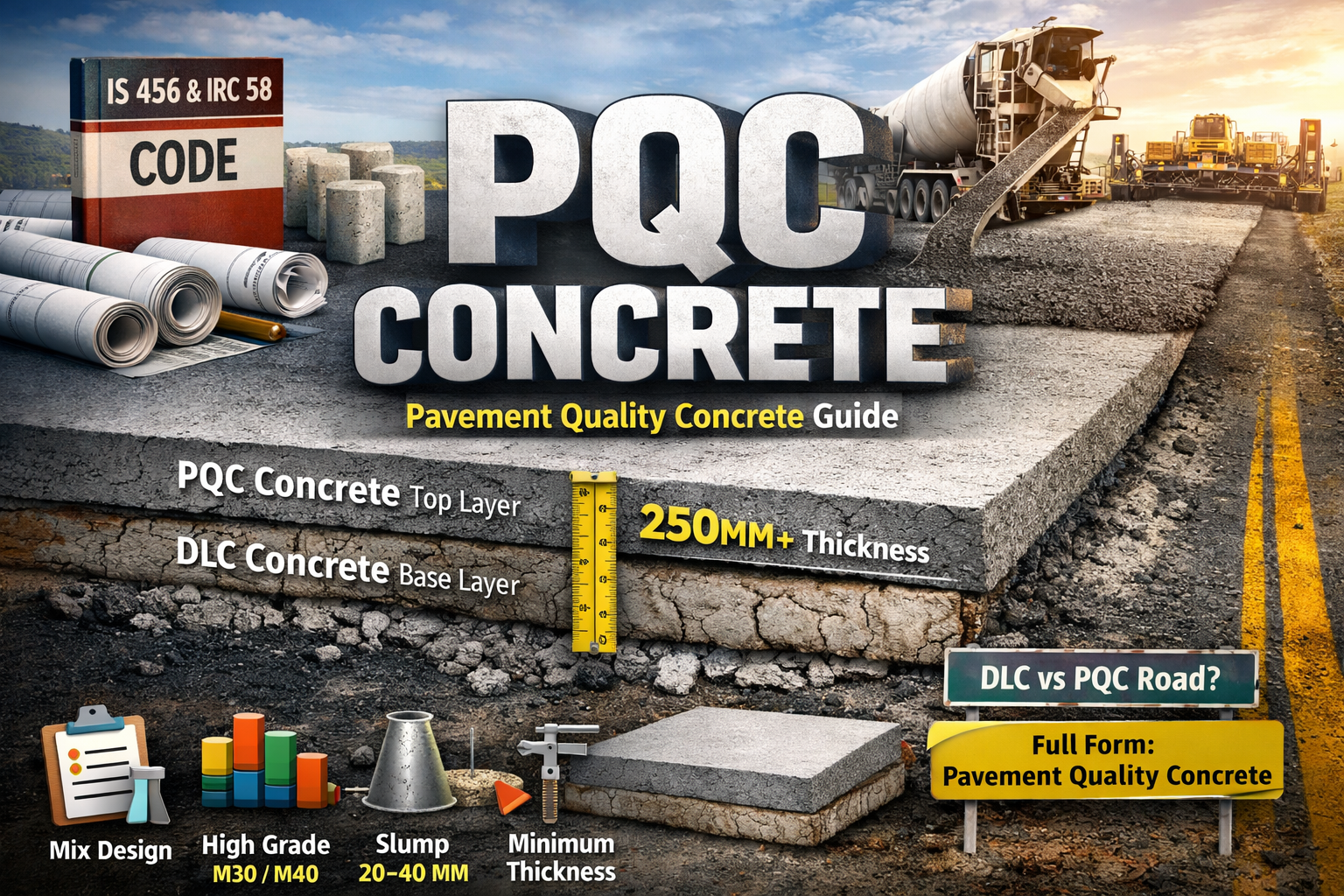
👉 PQC concrete is a high-strength concrete used as the top layer in rigid pavements (roads).
- It directly takes traffic load
- It is designed for high durability and strength
- Used in highways, expressways, industrial roads, airport runways
👉 In simple words:
PQC concrete is the final wearing surface of a concrete road.
What is PQC and DLC ?
This is one of the most common questions.
DLC Concrete (Dry Lean Concrete)
- Full form: Dry Lean Concrete
- Used as base layer below PQC concrete
- Has low cement content
- Provides uniform support
PQC Concrete
- Used above DLC
- High strength (generally M30 to M40 or more)
- Takes direct traffic load
Difference (Simple Table)
| Property | DLC Concrete | PQC Concrete |
|---|---|---|
| Position | Below | Top layer |
| Strength | Low | High |
| Cement content | Less | More |
| Purpose | Base support | Load carrying |
👉 On site, we always ensure proper compaction of DLC concrete before laying PQC concrete, otherwise cracks develop later.
PQC Concrete Mix Design
PQC concrete mix design is very important because:
- It must resist heavy traffic
- It must have low shrinkage
- It must have proper workability
Typical PQC Concrete Mix Design:
- Grade: M30 to M40
- Cement: OPC/PPC
- Water-cement ratio: 0.35–0.45
- Aggregates: Well-graded
- Admixtures: Plasticizers
👉 From my experience, maintaining the correct PQC concrete slump is critical. Too much water = cracks.
PQC Concrete Grade
The PQC concrete grade generally used:
- M30 (minimum)
- M35
- M40 (common in highways)
👉 As per IRC standards, M40 is widely used for national highways.
👉 Complete Guide for Prestressed Concrete ( PSC )
PQC Concrete IS Code
The design and execution of PQC concrete follow:
- IS 456 (General concrete)
- IRC 15 (Rigid Pavement)
- IRC 58 (Design of concrete roads)
👉 If you are preparing for exams, remember:
PQC concrete is mainly governed by IRC codes.
PQC Concrete Slump
PQC concrete slump is very low compared to normal concrete.
Typical range:
- 20 mm to 40 mm
👉 Why low slump?
- To maintain shape in slip form paving
- To reduce shrinkage cracks
👉 On site, I’ve seen that if slump increases beyond limit, surface finishing becomes difficult.
What is the Minimum Thickness of PQC?
The minimum thickness of PQC concrete depends on traffic load.
Typical values:
- Light traffic: 150 mm
- Medium traffic: 200 mm
- Heavy traffic: 250–300 mm
👉 For highways, we usually use 250 mm PQC concrete thickness.
Which is Better RCC Road or PQC Road?
RCC Road
- Reinforced Cement Concrete
- Used in buildings
- Steel reinforcement present
PQC Road
- Plain concrete (generally no reinforcement)
- Designed for pavement
Final Answer:
👉 PQC road is better for highways
👉 RCC is better for structural elements
Which is Stronger PCC or RCC?
- PCC = Plain Cement Concrete
- RCC = Reinforced Cement Concrete
👉 RCC is stronger because steel reinforcement carries tensile stress.
Which is Better M20 or M25 Concrete?
- M20 = 20 MPa strength
- M25 = 25 MPa strength
👉 M25 is better and stronger
What is M5, M10, M15, M20, M25?
These are concrete grades based on compressive strength.
| Grade | Strength (MPa) | Use |
|---|---|---|
| M5 | 5 | Lean concrete |
| M10 | 10 | Base layer |
| M15 | 15 | PCC |
| M20 | 20 | Residential |
| M25 | 25 | Structural |
👉 In PQC concrete, we use higher grades like M30–M40.
What is S1, S2, S3 Concrete?
These are slump classes:
| Class | Slump | Workability |
|---|---|---|
| S1 | 10–40 mm | Low |
| S2 | 50–90 mm | Medium |
| S3 | 100–150 mm | High |
👉 PQC concrete falls under S1 (low slump).
Which is Better PPC or OPC?
OPC (Ordinary Portland Cement)
- High early strength
- Faster setting
PPC (Portland Pozzolana Cement)
- More durable
- Better for long-term strength
👉 For PQC concrete, OPC is often preferred for early strength, but PPC can also be used.
Which is Better RCC Road or PQC Road?
Let’s compare practically:
| Feature | RCC Road | PQC Road |
|---|---|---|
| Cost | High | Moderate |
| Maintenance | Low | Very low |
| Life | High | Very high |
| Speed of construction | Slow | Fast |
👉 PQC concrete roads are best for highways.
Practical Site Experience (Human Touch)
When I worked on road projects, I observed:
- PQC concrete finishing is very critical
- Timing between DLC concrete and PQC concrete must be perfect
- Improper curing leads to cracks
👉 One mistake many beginners do:
They ignore curing of PQC concrete, which reduces strength.
People Also Search For (Covered Keywords)
DLC Concrete
Base layer below PQC concrete.
PQC Concrete Mix Design
Design for high strength and durability.
PQC Concrete Grade
Usually M30–M40.
PQC Concrete IS Code
IRC 15 and IRC 58.
PQC Concrete PDF
You can download IRC codes for detailed design.
PQC Concrete Full Form
Pavement Quality Concrete.
PQC Concrete Slump
20–40 mm (very low).
काँक्रीटमध्ये PQC म्हणजे काय?
👉 PQC म्हणजे Pavement Quality Concrete
👉 रस्त्याच्या वरच्या थरासाठी वापरले जाते
👉 खूप मजबूत आणि टिकाऊ असते
PQC आणि DLC म्हणजे काय?
- DLC = बेस लेयर (खाली)
- PQC = वरचा थर (ट्रॅफिक घेणारा)
Final Conclusion
If you want to understand road construction deeply, PQC concrete is one of the most important topics.
👉 Key Points:
- PQC concrete = Pavement Quality Concrete
- Used in highways and rigid pavements
- Works with DLC concrete base layer
- Requires proper mix design, slump, and curing
- Thickness depends on traffic load

Hi! I’m Sandip, a civil engineer who loves sharing about Civil Engineering & new ideas and tips. My blog helps you learn about engineering in a fun and easy way!